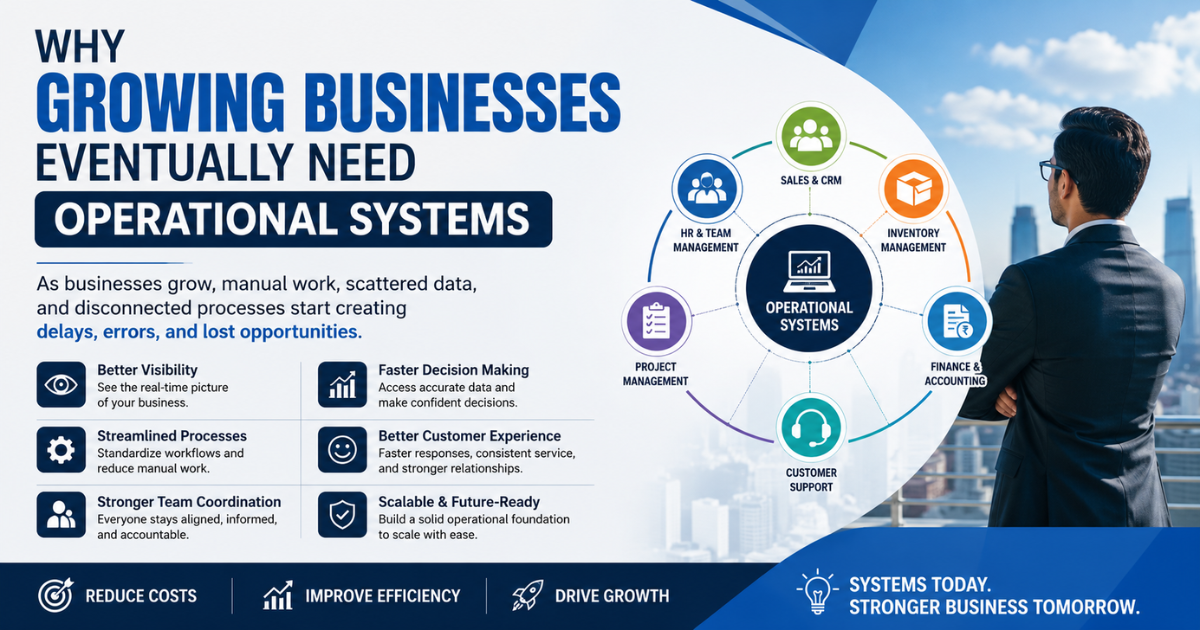
Most businesses don’t realize they need operational systems until growth starts creating operational confusion.
In the early stages, things usually feel manageable.
Sales are tracked on WhatsApp. Accounts are handled in Excel. Team communication happens through calls and scattered messages. Customer follow-ups depend on memory. Files are stored across laptops, drives, and personal folders.
For a while, this works.
Small teams move fast because there are fewer people, fewer processes, and fewer operational layers.
But as the business grows, the same flexibility that once helped the company move quickly slowly starts creating operational pressure.
Leads get missed. Reporting becomes inconsistent. Teams stop coordinating properly. Managers spend more time asking for updates than making decisions. Customer communication becomes delayed. Small mistakes begin turning into expensive operational problems.
This is usually the stage where businesses realize they no longer just need “software.”
They need operational systems.
At AB Tech Advisor, this is one of the most common patterns we see across industries. Businesses usually don’t start looking for systems because they suddenly love technology. They start looking because operational complexity begins affecting execution speed, customer experience, visibility, and long-term growth.
And once that starts happening, scaling without systems becomes extremely difficult.
Growth Creates Operational Complexity
Many businesses assume operational issues happen because of employees, lack of discipline, or communication gaps.
But in reality, most growing businesses simply outgrow their existing operational structure.
A company managing:
- 20 clients
- 5 employees
- one office
- limited daily transactions
can often operate manually without major issues.
But once the business starts handling:
- multiple departments
- larger teams
- repeat operations
- inventory movement
- customer support
- sales pipelines
- multi-location coordination
manual management starts breaking down.
The problem is not growth itself.
The problem is trying to manage a larger operational environment using systems designed for a much smaller business.
This is extremely common in Indian businesses where operations often depend heavily on WhatsApp communication, spreadsheets, phone calls, and manual coordination.
Eventually, growth reaches a point where management visibility starts reducing instead of improving.
Common Signs A Business Has Outgrown Manual Operations
Most business owners notice the symptoms long before they decide to invest in systems.
Some of the most common operational signals include:
Teams Constantly Asking For Updates
Managers spend most of their day:
- checking task status
- following up manually
- asking for reports
- coordinating between departments
instead of having centralized operational visibility.
Over time, this slows execution across the organization.
Data Exists Everywhere
Customer information starts getting scattered across:
- Excel sheets
- WhatsApp chats
- emails
- employee laptops
- handwritten notes
- disconnected tools
This creates inconsistency, duplication, and dependency on individuals instead of systems.
Reporting Takes Too Long
When reporting depends on manual compilation from multiple departments, decision-making slows down.
And by the time reports are ready, the actual business situation may have already changed.
Modern businesses need faster operational visibility.
Founders Become Operational Dependencies
In many growing companies, every important decision routes through the founder.
Approvals, customer escalations, operational coordination, pricing discussions, vendor management, and reporting all depend on one person.
This may work temporarily.
But it does not scale efficiently.
Businesses become operationally dependent on individuals instead of structured processes.
Customer Experience Starts Becoming Inconsistent
As operations expand, customers begin experiencing:
- delayed responses
- missed follow-ups
- inconsistent communication
- billing confusion
- support delays
A sales team may close deals quickly, but if onboarding, billing, operations, and support teams are disconnected, the customer experience eventually starts breaking down.
Most businesses notice this only after retention and service quality begin getting affected.
Why Businesses Delay Building Systems
Interestingly, most businesses already know they need better operational structure.
But implementation usually gets delayed for years.
Mostly because of three reasons.
Fear Of Complexity
Business owners often assume systems will:
- slow teams down
- require technical expertise
- complicate operations
- create software dependency
This usually happens because they have previously seen poorly implemented software environments that created more confusion than clarity.
Generic Software Does Not Match Real Operations
Many businesses first try ready-made tools.
But every business operates differently.
A manufacturing company, education institute, healthcare organization, logistics operation, retail business, or service company all follow different operational workflows.
When software forces businesses to work unnaturally, teams stop using it properly.
That’s why operational alignment matters more than simply adding software.
Growth Happens Faster Than Operational Structure
Most businesses prioritize:
- sales
- expansion
- hiring
- customer acquisition
while internal systems are postponed.
Eventually, growth outpaces operational visibility.
At that point, management becomes reactive instead of structured.
Operational Systems Are Not Just Software
One of the biggest misconceptions in business technology is assuming operational systems are simply dashboards or applications.
Good operational systems are actually business infrastructure.
They create:
- visibility
- coordination
- accountability
- reporting
- process consistency
- execution speed
across the organization.
The goal is not adding “more software.”
The goal is reducing operational friction.
When systems are designed correctly, businesses stop depending entirely on manual coordination.
What Operational Systems Actually Improve
When implemented properly, operational systems improve much more than reporting.
Centralized Business Visibility
Leadership gets structured visibility across:
- sales
- operations
- inventory
- finance
- support
- projects
- team execution
without constantly chasing updates manually.
This significantly improves decision-making speed.
Process Standardization
Without systems, businesses depend heavily on individual working styles.
Operational systems create consistency.
Tasks move through structured workflows instead of memory-based coordination.
This reduces operational confusion across teams.
Faster Team Execution
Teams spend less time:
- searching for information
- requesting approvals
- asking for updates
- manually coordinating work
This naturally improves execution speed and operational efficiency.
Reduced Dependency On Individuals
One of the biggest operational risks in growing businesses is knowledge concentration.
When important operational knowledge exists only in one employee’s mind, the business becomes vulnerable.
Operational systems reduce this dependency by creating structured processes and centralized information flow.
Better Customer Experience
Customers may never directly see backend systems.
But they experience the impact immediately through:
- faster responses
- better coordination
- smoother communication
- organized support
- accurate updates
- improved service consistency
Operational efficiency directly affects customer experience.
Real Business Scenarios
Manufacturing Businesses
Many manufacturing businesses initially manage:
- inventory
- dispatch
- procurement
- production coordination
through spreadsheets and manual communication.
As operations grow, visibility becomes difficult.
ERP systems and operational dashboards help centralize stock movement, production tracking, vendor coordination, and reporting visibility.
Service Businesses
Agencies and service companies often struggle with:
- lead tracking
- project coordination
- payment follow-ups
- client communication
- team accountability
CRM systems and workflow platforms improve operational coordination significantly.
Multi-Branch Businesses
When businesses expand into multiple locations, operational inconsistency becomes a major challenge.
Systems help standardize:
- reporting
- approvals
- communication
- inventory visibility
- performance tracking
across branches.
Education & Training Organizations
Institutes managing:
- admissions
- fee tracking
- attendance
- student communication
- internal administration
often face operational overload without centralized systems.
Structured operational platforms reduce manual coordination and administrative workload significantly.
The Shift Happening In Modern Businesses
Businesses today are becoming increasingly dependent on structured operational technology.
Not because technology is trendy.
But because operational complexity is increasing rapidly.
Modern businesses now expect:
- real-time reporting
- operational visibility
- faster execution
- automation
- integrated communication
- remote coordination
Businesses operating entirely through manual coordination will increasingly struggle against organizations with connected operational systems.
The Future Will Belong To Operationally Structured Businesses
Over the next few years, the gap between:
- operationally structured businesses
- and
- manually managed businesses
will grow significantly.
Businesses with connected systems will:
- make decisions faster
- scale more smoothly
- automate repetitive work
- improve customer handling
- reduce operational waste
- adapt faster to market changes
Technology alone will not create this advantage.
Operational clarity will.
Technology simply becomes the infrastructure enabling it.
Key Takeaways
Growing businesses eventually outgrow manual coordination.
Operational systems improve visibility, consistency, and execution speed.
The goal is not adding more software. The goal is reducing operational friction.
Businesses should build systems around workflows, not force workflows around generic tools.
Operational clarity becomes increasingly important as businesses scale.
Technology delivers the best results when aligned with real business operations.
Frequently Asked Questions
Q. 1. When should a business start implementing operational systems?
Ans. Usually when manual coordination starts slowing execution, reporting becomes difficult, or leadership loses visibility across operations and teams.
Q. 2. Do small businesses really need systems?
Ans. Not every business needs complex enterprise software in the beginning. But every growing business eventually benefits from structured operational visibility and process management.
Q. 3. Are spreadsheets enough for operations?
Ans. Spreadsheets work well temporarily. But once operations become interconnected across departments, they create fragmentation and dependency on manual updates.
Q. 4. Should businesses buy ready-made software or build custom systems?
Ans. It depends on operational complexity. Some businesses work well with standardized platforms, while others require systems tailored around unique operational workflows.
Q. 5. Will operational systems replace employees?
Ans. No. Good systems help employees work more efficiently by reducing repetitive coordination, manual reporting, and operational confusion.
Q. 6. How long does operational transformation usually take?
Ans. It depends on business size, workflow complexity, and implementation scope. Most successful operational transformations happen in phased stages instead of one large rollout.
Most businesses do not struggle because they lack effort.
They struggle because operations become harder to manage as growth increases.
At a certain stage, operational structure becomes just as important as sales, marketing, or customer acquisition.
Businesses that invest early in operational clarity, connected systems, and scalable workflows usually build much stronger foundations for long-term growth.
Technology alone is not the solution.
But properly designed operational systems often become the difference between businesses that constantly struggle with coordination and businesses that scale with confidence.
Businesses that build operational clarity early usually scale with far fewer internal challenges.